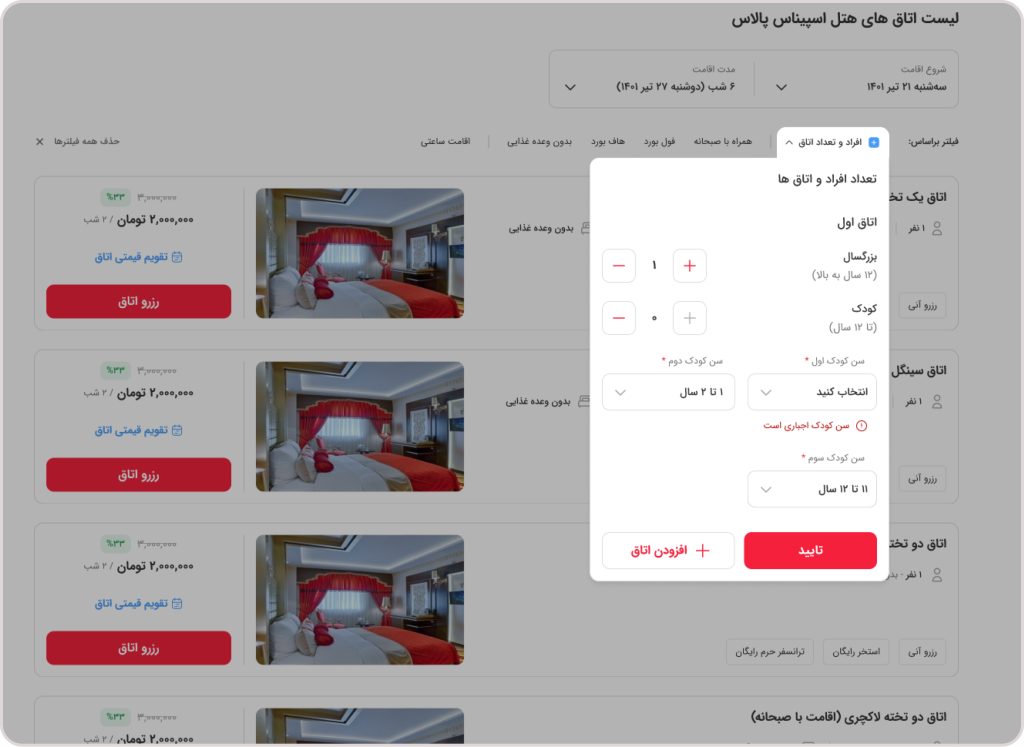
Reducing booking uncertainty for families and group travelers by introducing a guest-aware booking experience.
.
Project Summary
| Subject | Description |
|---|---|
| Company | Eghamat24 |
| Industry | Online Travel Agency (OTA) |
| AI Workflow | Claude (Research Review & UX Critique), ChatGPT (Content & Ideation), Gemini (Alternative Solutions), Figma Make (Interactive Prototyping) |
| Role | Product Designer |
| Team | Product Manager, Developers, Designers |
| Responsibilities | Product Discovery, UX Research, UX/UI Design, Information Architecture, Interaction Design, Prototyping, Developer Handoff |
.
The Story
Booking a hotel shouldn’t end with discovering that the room doesn’t fit your travel group.
While working on the hotel booking experience at Eghamat24, I noticed a recurring problem.
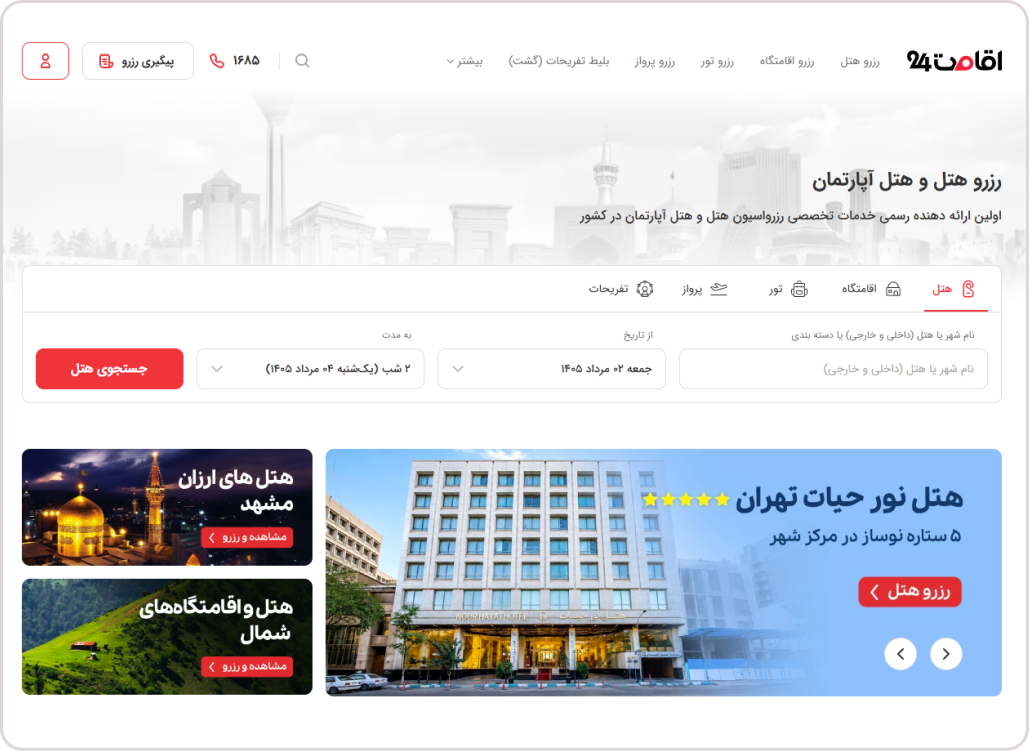
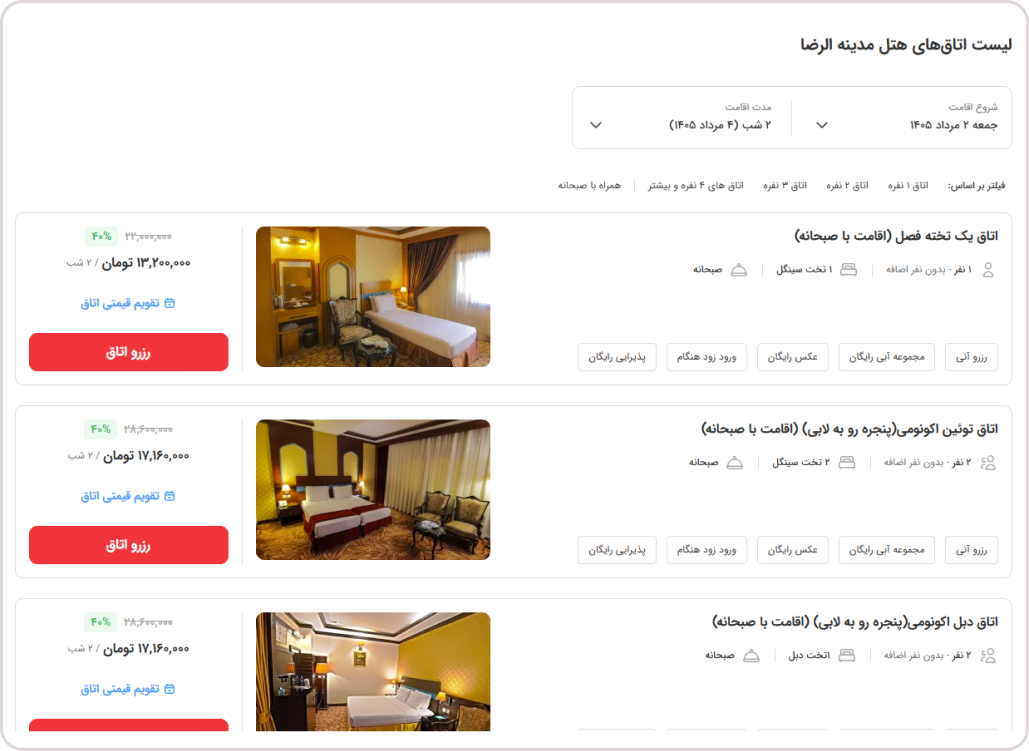
Users could search hotels only by destination and travel dates.
Critical information such as the number of guests, children, or required rooms wasn’t collected until much later in the booking journey.
As a result, many users spent time comparing hotels and evaluating rooms, only to realize near the end of the booking flow that the selected room wasn’t actually suitable for their trip.
This issue was particularly common among families traveling with children and larger travel groups.
The challenge wasn’t simply adding another filter.
The challenge was helping users make confident booking decisions much earlier in their journey.
.
Understanding the Problem
Through customer research, support questions, and stakeholder discussions, it became clear that the issue wasn’t limited to one specific feature.
Families traveling with children often struggled to understand whether a room accepted children, whether an extra bed was required, or how each hotel’s child policy worked.
Group travelers frequently discovered room-capacity limitations only after spending considerable time comparing hotels and rooms.
Users planning to book multiple rooms had no way to specify this requirement during hotel evaluation.
Overall, important information about room capacity and guest suitability appeared too late in the booking journey, increasing uncertainty and making decision-making unnecessarily difficult.
.
Discovery
Rather than relying on assumptions, I combined several research methods to better understand the problem.
The discovery process included:
- Customer Questions & Answers analysis
- Competitive Benchmarking
- Technical Workshops
- Stakeholder Interviews
One pattern repeatedly emerged.
Users weren’t asking which hotel was cheaper.
They were asking:
“Is this room actually suitable for my trip?”
That insight fundamentally changed the direction of the solution.
.
Competitive Analysis
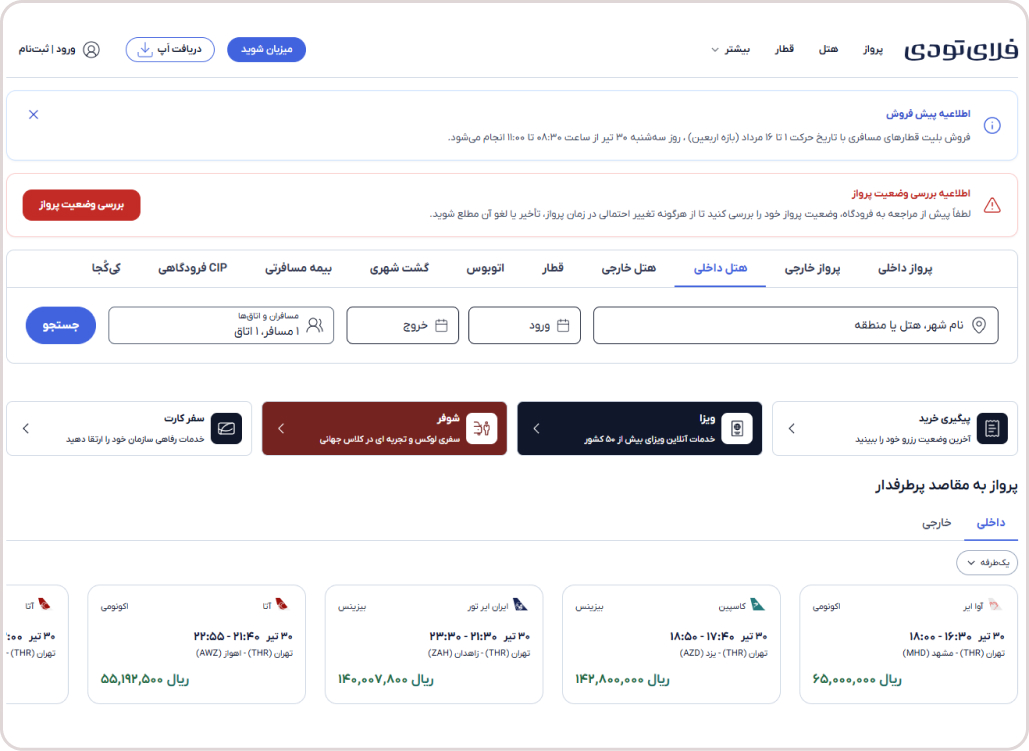
I reviewed several domestic and international booking platforms, including:
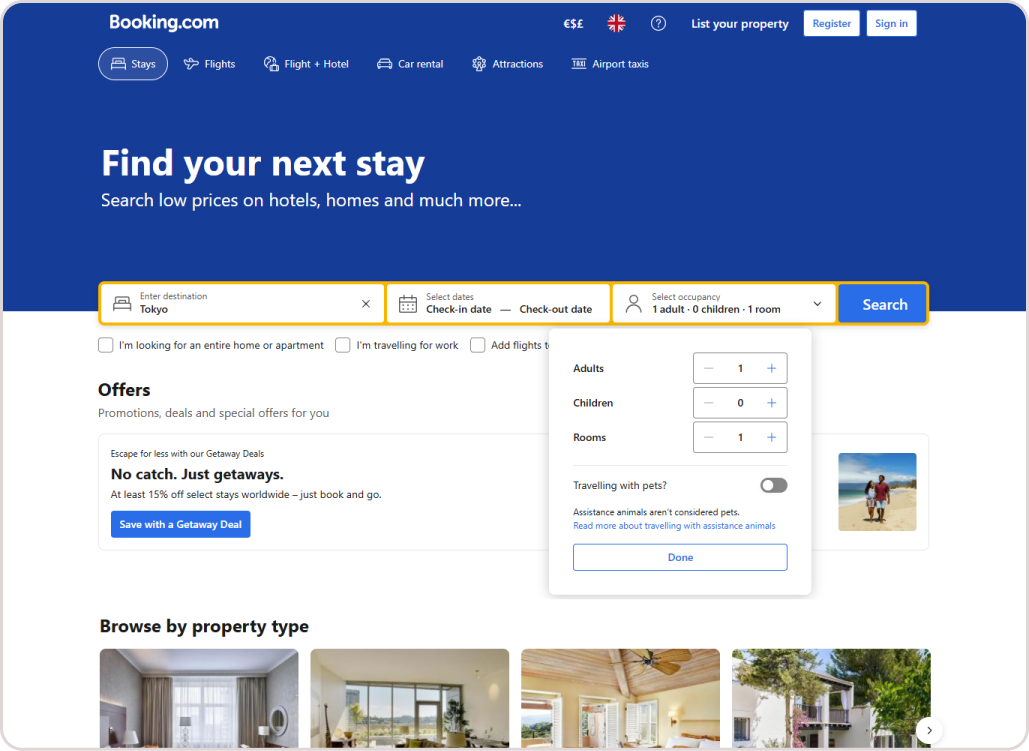
- Booking.com
- Agoda
- Expedia
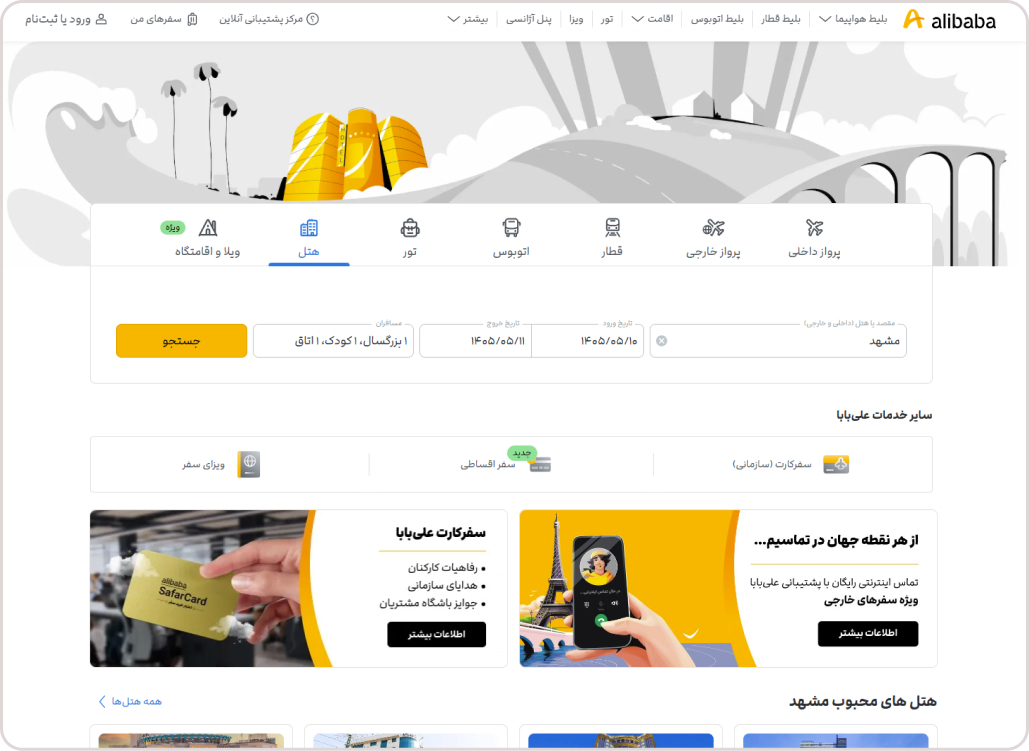
- Alibaba Travel
- FlyToday
- Snaptrip
- Iran Hotel Online
- MrBilit
A consistent pattern appeared across mature booking platforms.
Most of them ask users to specify guest composition—including adults, children, child ages, and room count—before displaying available rooms.
This enables users to evaluate only relevant accommodation options and significantly reduces booking uncertainty.
.
User Research Insights
One of the most valuable sources during the discovery phase was analyzing real customer questions submitted through the platform’s Hotel Q&A section.
After reviewing dozens of user inquiries, a clear pattern emerged.
Many users were not asking about hotel amenities or pricing—they were trying to understand whether a room actually matched their travel group.
The most common questions were related to:
- Room capacity
- Child accommodation policies
- Extra beds
- Multi-room bookings
- Family travel scenarios
.
Examples included:
“We’re a family of five. Which room should we book?”
“Can three adults stay in a double room?”
“Do we need an extra bed for our 7-year-old child?”
“How is accommodation for children under 12 charged?”
“There are no available rooms for four guests. How can I complete my booking?”
These recurring questions highlighted a clear gap between users’ expectations and the information available during the booking process.
Instead of confidently selecting a room, many users needed to contact support or search through the Q&A section before making a decision.
These insights became one of the primary inputs for designing the Guest Selection experience and improving room capacity visibility throughout the booking journey.
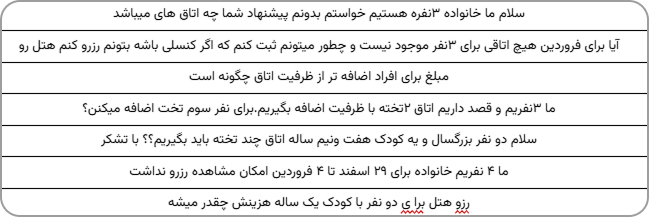
Examples of recurring customer questions analyzed during the discovery phase. These insights helped identify information gaps around room capacity, child accommodation, and family bookings.
.
Technical Constraints
The ideal solution was to introduce guest configuration directly into the search experience.
However, technical discussions revealed several constraints.
The existing infrastructure didn’t support guest-based availability, and hotel providers such as HotelBeds, Rayna, and TBO required different guest configuration structures.
Implementing the ideal experience required significant backend changes.
Instead of delaying the project, we decided to validate the idea through an MVP.
.
Design Goals
The redesign focused on four primary goals.
- Reduce booking uncertainty.
- Increase room selection confidence.
- Validate demand for guest-aware booking.
- Build a scalable foundation for future iterations.
.
Design Decisions
Every design decision balanced user value with technical feasibility.
Instead of redesigning the entire booking flow, I focused on the point where users made their most important decision: selecting a room.
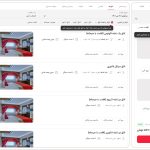
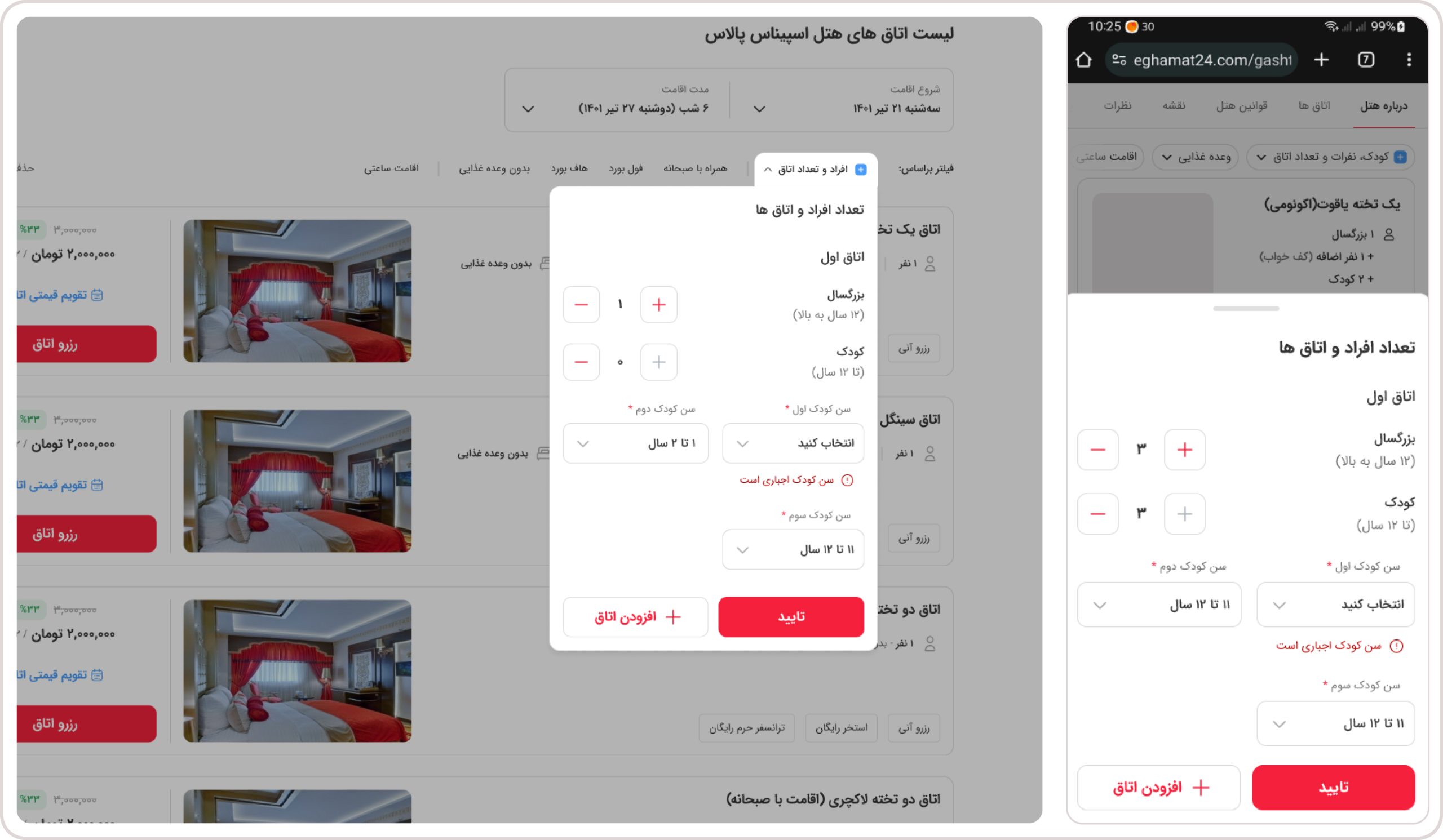
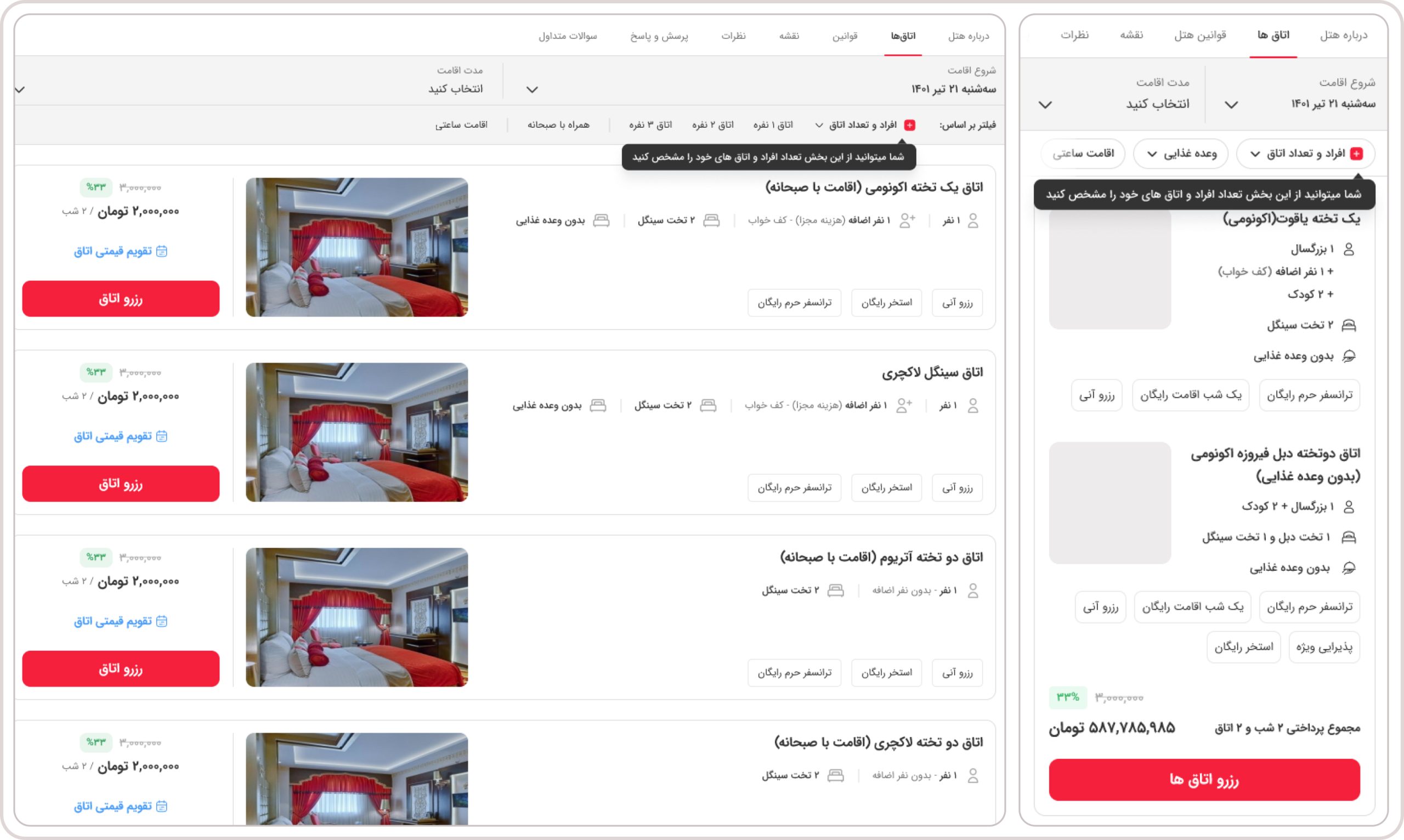
The first step was introducing a guest configuration component inside the Hotel Detail Page, allowing users to specify the number of adults and required rooms before comparing available options.
Based on these selections, room availability dynamically adapted to display only accommodations that matched the selected capacity.
Because child policies varied significantly between hotels and accurate pricing information wasn’t consistently available, displaying incomplete pricing could create confusion.
Instead, I introduced a dedicated visual badge indicating whether a room accepted children, helping families quickly identify suitable options without presenting unreliable information.
This approach significantly improved booking clarity while remaining achievable within existing technical constraints.
.
Usability Testing
Before finalizing the experience, we conducted usability testing to evaluate whether users could easily discover and use the new guest selection feature.
The sessions revealed an interesting finding.
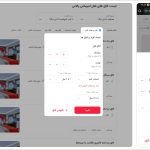
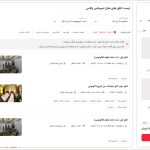
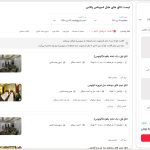
Although participants understood the feature once they interacted with it, many initially overlooked the guest selector because it didn’t stand out sufficiently within the page hierarchy.
Based on this feedback, I refined the visual hierarchy by increasing emphasis on the component through layout adjustments, spacing, and stronger visual prominence.
These improvements made the guest selector easier to discover before users started evaluating room options.
.
.
Solution
The final solution introduced a guest-aware booking experience that helped users evaluate room suitability much earlier in the booking journey.
Key improvements included:
- Guest Selection
- Room Selection
- Capacity-based Room Filtering
- Child Acceptance Badge
- Clearer Room Information
- Improved Booking Confidence
Rather than solving every technical challenge at once, the MVP addressed the highest-impact user problems while creating a scalable foundation for future development.
.
Success Metrics
To evaluate the effectiveness of the feature, the following success metrics were defined:
Business
- Increase bookings involving children
- Increase multi-room reservations
- Improve conversion rates for larger travel groups
User Experience
- Increase interaction with the Guest Selector
- Reduce capacity-related support questions
- Reduce booking modification requests
- Improve booking confidence
Product
- Guest Selector adoption rate
- Guest configuration completion rate
- Usage before room selection
- Validation for future guest-based search experiences
.
AI-Assisted Workflow
Throughout the project, I used AI-assisted tools—including Claude, ChatGPT, Gemini, and Figma AI—to support research synthesis, interface reviews, design exploration, documentation, and rapid prototyping.
These tools accelerated repetitive tasks and expanded exploration, allowing me to dedicate more time to understanding user problems, evaluating trade-offs, and making informed product decisions.
AI supported the workflow, while product strategy, prioritization, design decisions, and final execution remained entirely human-led.
.
Reflection
This project reinforced an important lesson.
The best solution isn’t always the most comprehensive one.
By balancing user needs, business goals, engineering constraints, and implementation effort, we were able to launch an MVP that solved a meaningful customer problem while establishing a scalable foundation for future iterations.
It also demonstrated how usability testing and behavioral insights can refine design decisions beyond initial assumptions, ensuring that valuable features are not only implemented but also discovered and used by customers.